Sunday, August 07, 2011

My Grandmother Pauline: A Life-Long Story 1914-2011

(Part 1 of My Grandmother Pauline's Story)   This is Part 2 of Pauline's Story
Pauline 1914-2011

A tornado swooped down into the Beech Creek Hollow of Tennessee in 1936 and several lost their lives. My dad, a small boy, told of being lifted into the air by the cyclone and Daddy grabbing his ankles to pull him down. 

The tornado did take Pauline's mother, Sally May, on that fateful day. She got up to shut the door of the rough-hewn house and her treadle sewing machine came crashing into the back of her head, killing her. Years later I remember the story being told as if yesterday, tears in the eyes of those who knew Pauline's mother, as they gently pulled back the rag rug covering the blood stain on the ancient wood floor. It was a violence they didn't get over.


But Willie, Pauline's Dad, was still young and he remarried. He married a woman called Tildie (Tilda) and Pauline warmed to her Dad's choice for a bride. This was the woman I remember. "Tildie" was more like a term of endearment. Even so, no one forgot Sally May, Pauline's mother who had so many children. 


The years were difficult with Roy teetering between bouts of alcohol and gambling, and preaching the Bible at a church. At least twice he gambled away the family business. Pauline kept working during these up-and-down roller coaster days of the 1940s and 1950s. Some went off to WWII, including several in the family and her brother-in-law, Pat Warren (he was at Pearl Harbor and lived to tell about it.) Then, the 1950s came along with my dad marrying my mother and their lives once again were marked with conflict--this time the Korean Conflict. 

Wilburn in the army

Wilburn Warren, U.S. Army
In 1953 when my dad was summoned to go into the army, he took his new bride of two years home to his parents so she would have people to live with and take care of her while he was gone. My grandparents still had small children at home--a son, a daughter and a granddaughter, but they scooted over and took "Lin"(my mother, Lillian was called this by his family) right into their hearts and home.

Pauline worked, Roy had a job, too, and so, it was decided that Lin would care for the children at home. During the time Pauline's son was away, there was a lot for them all to get used to, but Pauline took it all in stride. Lin had an education, had worked in a hospital and had a natural way with discipline and love with kids, so it wasn't a trial, but a time for love to grow among the family. That time bonded them all. 

By 1956 not only was Wilburn home, but Lin had 5 miscarriages. Wilburn took a job driving a semi-truck hauling automobile parts in the Midwest in November of 1957, so they settled in Indiana to be close to Lillian's sisters and to be close to the dispatch terminal of Wilburn's job. Then, I was born. I was a miracle baby and Lillian wasn't sure she would ever be able to have another child.
 
Wilburn Warren with his new baby, Crystal
Pauline was anxious to see this miracle baby grandchild with white blonde hair, but she would have to be satisfied with photos for awhile because everyone had to work, and no one had money to travel, anyway. My mother named me Crystal before anyone could influence anymore name choices (Pauline suggested Sally--her mother's name, the one who died in 1936 in the tornado.) But Lillian had her way and the name Crystal was it. 

When the Tennessee family got the card announcing my name, puzzled, they said, "Why would she name that darlin' 'Cry-Tail'?" until Linda pointed out it was Crystal. So, not to be totally out done, they settled on calling the new family member Crissy. To this day that part of the family calls me Cris or Crissy. I answer to any variation. 

Lillian's mother died from TB when Lillian was only 5-years-old. And it looked as if her mother's fate would also be hers. Lillian had 9 siblings, but I had none. In 1958 she was diagnosed with tuberculosis and was required to go to the Irene Byron Hospital in Ft. Wayne, to have her TB treated. She had to find someone to care for me full time, as my dad needed to keep working as a truck driver, so once again, Wib called his mother and asked if she would take me.

Everyone knew there was a chance my mother would not survive. So, I was taken to Tennessee and my mother made her mother-in-law promise that if she survived and came home, she wanted me back. Grandmother said ok. 
Mama Pauline taking care of her granddaughter
My mother said once that if she had known what she was in for, she might not have made it. One surgery was so invasive, it would seem the "cure" would kill her. They removed all but one lobe of one lung and broke and caved the rest of the ribs on the empty side to fill the cavity. It was brutal. She lived the rest of her life trying to breathe. Any physical labor was difficult.
Crystal in Tennessee in a dress fashioned by Pauline (I still have this dress, it is see-through blue.)


Meanwhile in Tennessee, Linda, a young aunt of only 13 took care of her baby niece. I slept in her bed. She would stick a bottle in my mouth to keep me quiet. (This later would cause me a lot of painful surgeries.) It was a lot of responsibility for a young teen, but with everyone else working to survive, it was the only option. Linda ended up quitting school. (Later she would go on and get her GED and became very successful in business.) 
Crystal with Granddaddy Warren in Tennessee
There are no photos of Aunt Linda and me that I've ever seen. I think she took all of the photos, so she wasn't in them. Once, her daughter, Annette, told me that I had scribbled in all of Aunt Linda's yearbooks and books (obviously, as a toddler I wanted to "write.") Annette said it in a way that made me realize I was a burden and a hardship to them all. As an adult I only heard a few snippets of my time with them. I'm sure it was especially hard on my Aunt Linda and she didn't really want me there at the time.

Aunt Linda, a young teen in this photo, who had to take care of me


It looked as though they would be "keeping" me as things weren't too bright in Indiana. But as the months turned to a year and then beyond, Grandmother Pauline wrote letters and would have me to "write" to my mother. "Mama Lin" was someone people around me talked about but I didn't know who she was. 

Crystal at Christmas in Tennessee. My mother's photo was placed next to me. My mother cried all day when she received this photo.

Because my Grandmother had become "Mama" and Granddaddy was now "Daddy, " I later would be very confused when I finally did go home to get reacquainted with my parents.

Linda took photos to send to Lin, Pauline labored over letters that she really didn't have time to write just so my mother would have information on her only child. Finally an opportunity came for my mother to see me. My Dad came through to pick my mother up for a weekend leave from the hospital. She was under strict orders to not leave the area as she was still recovering. Lin was stubborn and she got my Dad to slip off on a whirlwind trip to Tennessee, which would take many hours on treacherous back roads. She endured the trip there and back in order to see me.

One of the photos snapped by Aunt Linda


One of the "posed" photos by Aunt Linda--she had me imitating Bub Pope, someone they knew

Lillian on her AWOL weekend from the hospital. No doubt she wasn't supposed to be lifting weight.


Monday, August 01, 2011

My Grandmother Pauline: A Life-Long Story 1914-2011

Part 1
My Grandmother Pauline with Me ("Crissy") and Little Dog, Candy on a Tennessee Porch
On September 20, 1914 a girl was born to William James and Sallie May Pulley. Their house was already filled with kids, and more would follow this born-in-the-middle, spunky girl who would earn the nickname "Top" amongst her seven siblings (being 8 kids in all.) Every one of the Tennessee Valley Pulley kids had nicknames, too, and there was plenty of teasing and fun in between their hard work that no one got out of on a farm where a family cemetery already cradled their kin before them. Life wasn't easy, but there could be joy between the sorrows and pain. On July 30th she joined her kin both in the cemetery on Warren Hill, but also at the reunion in heaven.

It's fun for me to peruse through the names of those people who share my history, but Pauline Pulley Warren Pope would do more than just make me dresses, sew my wedding quilt or send me small tokens of jewelry for birthdays--she would take me (and my dog, Candy!) into her home when I was a small child still in diapers and drinking from a bottle, while my mother battled for her life in a TB hospital in Ft. Wayne, Indiana.

But back to her siblings. See if you think her brothers and sisters had interesting names and nicknames. I knew their nicknames long before I ever knew their real names!:

Effie Opal ("Jinks")
Gladys Leona ("Short")
Ernest Clayton ("Doc") He got this nickname from doctoring his sister with a dung ball covered in flour to resemble a pill to "help" his sister's headache. Yeah, pesky Doc! 
Pauline (no middle name) ("Top")
Earley Clifford ("Cliff") A man who was full of "ginger peachy" until the day he died.
Ollie Larken ("Lark") Another pesky feller.
Mary Lois ("Head") I remember her warm, kid-filled house, and her boys who found it funny to loose-saddle a horse for me, hitting him on the behind, and then laughing themselves silly as I hung on while my saddle slid underneath.
James Edward ("Ton") He won my dad's marbles back for him when some mean boys at school scammed him out of his only toy. He was my dad's best friend and died from cancer way too soon, his son and wife being a friend to me when I was just a kid. 


My Dad, "Wibby,"(Grandmother's 1st son) with his uncle "Ton" (Grandmother's youngest brother) in "fun" days

I don't remember Grandmother Pauline talking much about her childhood, except calling her father, "Dad" and about how much he loved his children. She spoke about him with respect. When she was 16-years-old, she fell in love with a 24-year-old man named Roy Lee Warren. She planned to elope with him one evening, but before she could "run off," Dad caught wind of it from one of her brothers, and he sat her down to talk to her. He was a little heartbroken, and said to her (quoting Grandmother, and I hear it in his Southern accent) "If you think more of him than you do me, then go on and run off. But you can stay with us if you have another thought." 

A Young Pauline
She was wild about the raven-haired Roy, so off she went to marry and keep house on April 4, 1931. Justice of the Peace J.F. Melson officiated. 
 
Roy Warren, Pauline's First Love on a Tennessee Road

Her first child, Clara Nell ("Nell") was born nine months later. She wouldn't have her second child, my Dad, Wilburn Andrew, (who took creative license with his birth certificate at 16,) until a year later. 
Nell (Warren) and Rob Davis

My Dad has a story all his own and at 16, he ran away from home to Indiana, got a woman to attest to being present at his birth in Tennessee (she wasn't,) and dropped the hated "Andrew" name. I'm pretty sure my Dad gave Grandmother more gray hairs than she should've earned. To fit into Hoosier life, he also changed the childhood name "Wibby" to Bill, and "Wibby" was always called this by his Tennessee family, but everyone in Indiana called him Bill.

"Wibby" Warren, my Dad, with my mother's nephews, Mike & Dan, long before I was born

When Dad married my mother he called home and said, "Get the cradle out, I'm bringing home a wife." My mother was not pregnant and on top of this, he had told my mother that he was adopted. He wasn't. Imagine everyone's surprise when she brought this up to his sisters and mother. Grandmother in a half-way teasing voice said , "Law, if he weren't mine, I'd a'never taken him!"  

Lillian and Wilburn Warren in Tennessee early in their marriage
Besides leaving the bosom of his family and never moving back home, (which most of them never left Wayne County, Tennessee,) he brought home a strange "Northern" woman with a Minnesota/Scandinavian accent. Pauline's second child was a worry to her from early on.  
Sue Warren (Morris) with my mother, Lillian Warren in Tennessee

A year later after Wilburn was born, she would have another child, Melba Sue, and then she got a reprieve from being pregnant for eight years.  Alton Lee wouldn't be born until 1942. Alton would suffer from "spells" (epilepsy) until he died in 2008. He was my Grandmother's "baby." 

Linda Ann, the youngest of Pauline's and Roy's children
Two years later the last child which she would be pregnant with, Linda Ann, would come to live with the Warrens, but she would not be the last child Pauline kept in her home. All of these children called her "Mama," including her grandchildren, and she worked hard both at home and at her jobs. When her daughter Nell married young, had a daughter, Gayla Paulette, divorced and then married Rob Davis, Gayla came to live with her grandparents and didn't move back with her mother until later. Gayla would always call her grandmother, "Mama." 

All of the Warrens: L to R back: Alton Lee, Wilburn & Lillian, Pauline, Roy, Rob & Nell. L to R front: Linda Ann, Gayla, Sue
She worked 24 years at the shoe factory, GENESCO, in Wayne County, Tennessee. She was not without hobbies though, and sewed, crocheted, played mean games of ROOK and BINGO, and loved fishing more than anything else. 

Through both her marriages (my Granddaddy Roy died in 1972 and she married Hiluard A. Pope in 1976 who died in 2002) she fished whenever possible. The early years would be on the "river"--Buffalo River or Tennessee River--near Clifton, Tennessee, and the family homeplace and then she fished the Atlantic Ocean when her husband, H.A., would take her to Florida for deep sea fishing. 

Nothing was better than fishing, and I think she didn't even care if she got to eat the catfish, brim,bass or perch that they caught. Her hushpuppies were renown, though, and she could not only bait her own hook, but could expertly clean and cook her catch, too. Later when she no longer could go fishing, it was a treat to go to local establishments to eat fish and remember "good times" on the river. 

Part 2 of Pauline's Story


Friday, July 15, 2011

Drawing from Your Everyday Life


This is a tree in our backyard. I know it's hard to see, but it's carved with "T 'heart symbol' D." When we first moved here fifteen years ago, I imagined all kinds of scenarios because I knew the names of all the people who lived in this house before us, and none of them were a T or D. Also, they bought the land from farmers to build this house--the house had only been there for two years. I figured I would never know the "rest of the story" of the romantic tree.

Then, one day, a man stopped by. He seemed a little embarrassed and said to me, "Several years ago I was dating a woman and we came to this land and carved our initials on a tree in your backyard. Is it still there?"

I assured him the tree was still there and the initials were still visible. 
He smiled and said, "Let me explain. I asked her to marry me there and we carved that into the tree. At the time no one lived here, and there were more trees on this lot. We asked the owner to sell us this land to build a house. He wouldn't sell. Then, years later he did sell it to a couple, not us. We bought land over the ridge there and built a house there. We're actually your neighbors now. I'm Tim. My wife, Debbie, is in the car. We were wondering...could we go back there, take a photo by the tree? It's our anniversary." 

Well, what would you say?
I didn't even peek, though my extreme curious nature wanted to take notes, ask more questions and yes, take a photo. It was a private moment for them and I wasn't going to spoil the moment. I later got to know them better and they are a nice couple. But how often do you actually get to know the rest of the story? A love story! 

I make up stories, have friends who make up stories. Do you ever take one of those true life moments and make up a story from it? If you are a writer, you will use everything from your life that intrigues you. Things like this can launch a novel.

This week I decided I needed to look around me more for things like this, so I took this photo--almost too late, as it's getting rather grown out. I'm going to be a lot more aware of these interesting little tidbits that would fire my imagination. My little life right here in Bird's Nest, Indiana. My life. It's what I know best but tend to take for granted. No more.

By the way, my real home is not Bird's Nest. I made that up. But it really looks like Bird's Nest, Indiana here. The town has sprung up around that tree. That very romantic tree. Can you see it?

Do you have a true life tidbit that has launched a story for you? What sort of prompts do you use?

Thursday, July 14, 2011

Posting at The Barn Door Today

Go over The Barn Door today to read about my Midwest Writer's Dream Office Come True.


Friday, June 24, 2011

Winner of Benevolence by Teena M. Stewart

Winner of the book, Benevolence: Ministering to the Poor and Needy by Teena M. Stewart, is Lorlynn! And I also drew a second winner whom I will send a copy of the book to, as well, is Christa! Look for my email asking for your addresses.

Do go check out Teena's book and do consider donating to or visiting Java Journey. Find ways to be benevolent in your life!

Thursday, June 16, 2011

Benevolence: Ministering to the Poor and Needy--Do You Have the Tools Necessary?

Teena has been my long time friend and critique partner, as well as someone who has co-authored columns with me. We have been in a group of friends/writers for many years and know each other's secrets, pains and joys. Not only is she gifted in many areas of writing and art, but she and her pastor husband, Jeff, have been involved with ministries their whole married life and now are running the innovative Java Journey, a coffee house ministry in Hickory, North Carolina full of life, art, music and people. If you're in the neighborhood, do stop by! (Tell 'em Crystal sent you!) 
She just published another book with Beacon Hill Press called Benevolence: Ministering to the Poor and Needy, and she also will give away a copy to one commentator here, which I will draw from on this blog. Leave your questions and comments below and your contact email and this weekend I'll draw one name to give to Teena (she will send it out early next month.) If you have trouble posting, email me at crystal.mrsinewaATgmailDOTcom with your email and comment and I'll enter you and send your comment to Teena. YOU MUST sign your comment if sent by email. Please leave your email on comments below.

Many people want to help others, but do not always have the know-how of what to do. Ministry or benevolence teams go through many starts and stutters, burning out in the process, and Teena has much experience in how to avoid pitfalls and well-intentioned mishaps. This book will help you, your church or group to find ways to minister in effective and healthy ways. I asked her some questions to help us to understand just what it's all about.
Author and My Friend, Teena M. Stewart

In Benevolence, Teena Stewart shows us how to start a benevolence reserve in a church, helps us recognize charity opportunities, considers how different ministries can work together, and gives us ideas on how to manage those benevolence opportunities and ministries. With this book, learn everything you need to know about starting and keeping a ministry going.

Teena realizes, and points out in this book, that benevolence is a practiced, harnessed skill and one that needs accountability, and will change our lives. The truth is that we do have the capabilities, organization, and passion to start a benevolence ministry; it's just a matter of keeping it.

Crystal:  What motivated you to write this book?

Teena: At the time this book was conceived I was on staff at Northgate Christian Fellowship Church in the San Francisco Bay area. I saw the needs of the hurting and broken as they came in or called in and how they were handled.  I also helped organize a special event where we coordinated multiple opportunities for our church members to get involved in area charities and service projects. I learned volumes.

People often want to help the needy or local charities but do not know who to help, or how to go about it in a healthy way. Individuals might give money to someone in need in order to cleanse their conscience but without thought to whether it will truly help them or not. I am a natural encourager and equipper and I wanted to share my knowledge regarding how individuals and churches could have a positive impact on helping hurting people.

CLM:  Why should we care about the poor and needy?

TMS:  Many people claim to follow the teachings of Christ. A sign of Christian maturity is our willingness to look beyond our own needs to care for the needs of others. Scripture references more than 2,000 passages regarding the poor and needy.  Giving back is clearly important to God.  
Teena (third from left) has been a part of service and ministry since she was small. This is Teena's Baptist GA group as a young girl


CLM:  What has your present work for a women’s rescue mission taught you about helping the needy?

TMS:  I have worked in a number of capacities at Safe Harbor Rescue Mission in Hickory, NC, most currently as their Resource Warehouse and Gallery Director. The experience has been amazing. I’ve learned so many things. First, that sometimes people have landed in difficult life circumstances because they had no choice. Some have had really difficult upbringings. In other cases it is because of poor choices. Sometimes they remain broken or in need because of emotional illness or physical disabilities. It has taught me to look at the underprivileged and hurting with new eyes. It used to be I would see a homeless person and think, “why don’t you just get a job?” Now I look at them and consider the myriad of things that may have brought them to that point.  I’ve also learned how many hands it takes to turn one life around.

CLM:  Tell us a little more about your book.

TMS:  I spent a lot of time interviewing different people involved in benevolence ministry for this book. So you will find those accounts in the book. The book also includes advice for developing benevolence teams and boards, sample mission statements of charitable ministries, guidelines, policies and procedures for handling benevolence needs, resources, outreach ideas, promotional ideas. It also has an appendix of benevolence resources, and chapter questions to help readers reflect on best benevolence practices related to benevolence ministry.

CLM What is the exact book title and where can people purchase it?

Benevolence: Ministering to the Poor and Needy by Teena M. Stewart
TMS:  It is called Benevolence: Ministering to the Poor and Needy by Teena M. Stewart (Beacon Hill, 2011) and you can find it at most book stores including online entities such as amazon.com or on the Nazarene Press website .( It is available after June 1, 2011.)

 TEENA M. STEWART has served in ministry leadership for years, most recently at Northgate Christian Fellowship in Benicia, California and at Java Journey Coffee Shop Ministry in Hickory, North Carolina  where she and her husband, Jeff, an ordained minister, currently serve in market place ministry. Stop in for discussions on all of life's issues and a good cup of coffee your way!
Teena's published articles have appeared in Leadership, Discipleship Journal, Ministry Magazine and many other publications. Book credits include Successful Small Groups from Concept to Practice (Beacon Hill), co-authoring The World's Easiest Pocket Guide to Money and Marriage with Jeff Stewart and Larry Burkett and contributions to several anthologies, most recently Follow Your Dreams (Thomas Nelson.)

For more info on Teena's writing visit http://www.teenastewart.com where she has also designed logos for writers, web sites and can do any writing services.

Teena is also an artist and jewelry designer. Visit her art website at http://www.serendipitini.com. I happen to own several of her jewelry pieces, which are beautiful! Do go check this out and do contact Teena if you'd like to commission a piece of jewelry or art.

In addition, she has used her administrative and creative skills to oversee and launch Safe Harbor Rescue Mission's Resource Warehouse and Gallery.


The Java Journey 2011 from Jeff Stewart on Vimeo.

Wednesday, June 08, 2011

First Lines and How They Get Your Readers

My latest WIP and opening line

First lines. Who loves them? Sometimes we've been told to wait until you've written the whole book before writing that opening.And yes, it could mean the difference between a rejection from an editor or agent, or a request for a whole manuscript. So, I think about this often for not just my manuscripts, but also anyone's manuscript that comes across my desk.

Noah Lukeman has a whole chapter about adjectives/adverbs in his book, The First Five Pages: A Writer's Guide to Staying Out of the Rejection Pile.He talks about overuse and how you do not want to pepper your manuscript with them. He says just cut them. But he also says to replace common ones with unusual ones. Get ones that draw attention. Strengthen your nouns and verbs. Or substitute a comparison, analogy or metaphor. Use this advice for your opening lines, too.

I decided to look at some books I pulled off my shelf. Try it with your favorite authors, too. Mary Connealy is one of my favorite authors and here are some openings of her books:

Montana Rose: "Cassie wanted to scream, Put down that shovel!"

Petticoat Ranch: "Sophie heard God in every explosion of thunder as she listened to the awesome power of the approaching storm."

Petticoat Ranch was one of her early books. Montana Rose came later. Can you see a difference in the openings?

This is from Gingham Mountain: "Martha had an iron rod where most people had a backbone."

She sure can tell a story and she pulls me in every time. I'm anxious to get into some I haven't been able to read yet because I've been doing a lot of judging and book reviews for magazines.

Can you choose a book to share from the opening? I think writers often choose books differently than just straight readers. We have a whole set of criteria that intrudes into our selection process. So tell me, does a first line or opening scene clench the choice? Or is it something else? Here are some others I pulled from the shelf. Do any of these grab you or would it be the author or genre that would be your first criteria?

By Darkness Hid by Jill Williamson (Blood of Kings Book 1):
"Achan stumbled through the darkness toward the barn. The morning cold sent shivers through his threadbare orange tunic."

Missing Max by Karen Young:
" They say people have a premonition about calamity before it strikes. But Jane Madison felt only irritation when her cell phone rang as she waited in the Mardi Gras crowd to order shrimp po' boys."

She Walks in Beauty by Siri Mitchell:
"'Get dressed, Clara. In your visiting costume. We are going out.' My aunt's words were at once both commanding and precise--as precise as her posture: a series of ninety-degree angles, seated upon one of my bedroom chairs."

Almost Forever by Deborah Raney:
"Bryn drew the queen of diamonds from the stack of playing cards on the wobbly table between her and Charlie Branson. The grizzled Vietnam vet eyed her from his wheelchair as she discarded an ace."

A Woman Called Sage by DiAnn Mills:
"Life didn't get any better than having the love of a good man and his baby kicking against her ribs. Add a summer breeze to cool the heart of a southern Colorado sun and a bed of soft green grass tickling her feet, and Sage felt a slice of heaven had come to earth."

Lukeman points out these things that could draw a rejection for your manuscript: (And realize that he is speaking about the first five pages:)
1. A weak opening hook.
2. Overuse of adjectives and adverbs.
3. Flat or forced metaphors or similes.
4. Melodramatic, commonplace or confusing dialogue.
5. Uneven pacing and lack of progression.

While openings are only one portion of the entire manuscript, you usually only get one shot at the first few pages to attract attention. Here's the other thing we didn't talk about yet--sometimes the opening which caught the agent/editor's eye to start will get changed before it's published. (Yeah, it happens. Go figure!)

All this isn't written in stone, but seeing many openings of published books shows you how it has been done by those who are published. When you pick up a book in the bookstore, Steve Laube, a bookstore manager-turned-editor-turned agent, says you only have a scant few seconds to capture that reader before he puts down your book and picks up the next one. There is something to writing that opening paragraph. Once you've written your book, go back and look over your opening with fresh eyes before sending it out. Get Lukeman's book and work on his exercises. Run your opening past a few people who know nothing about your book to test it.

Are you trying to pick your next book to read? Want to entice us with your own book (published or unpublished?) Throw out a few sentences to let us pick!Throw us the opening sentence or especially if you're trying to decide.

The First Five Pages: A Writer's Guide to Staying Out of the Rejection Pile by Noah Lukeman is a book for every writer's shelf, so be sure to get a copy.

See my posts at Hoosier Ink, along with other Hoosier Writers.

Those Opening Lines

Sunday, May 15, 2011

Dark Secrets, or Just a Simple Question of What Street Did You Live On?

In the past I've revealed my mother's family's dark secret--that her grandfather was a harsh man who never mourned his children he had put into harm's way. He drove his wife to shamefully filing for divorce at the turn of the century by his cruelty to her. That wasn't a common occurrence where the woman left the man and divorced him. One other daughter was committed to one of the first mental institutions after the death of her brother and sister and her father's cruelty. These mental institutions sprang up after Dorothea Dix fought for better care for the mentally ill.
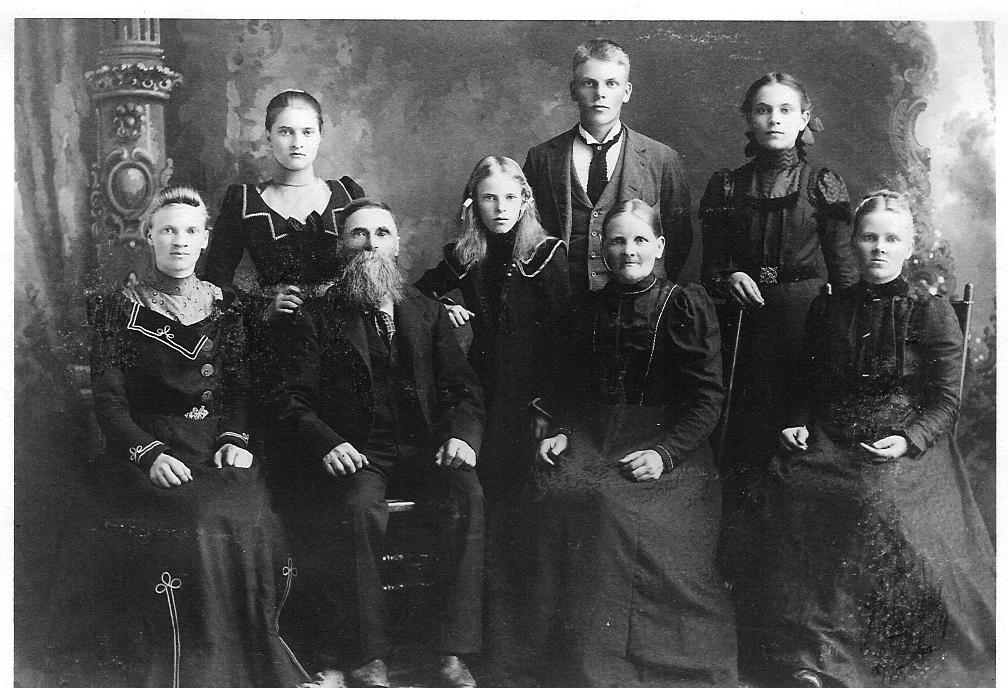
My Pierson family at the turn of the century, my Grandfather Aaron is on the back row
Here (above) is the official family portrait of a hardworking farm family and it is missing a couple people--Oscar, who died in the barn fire, and Esther who died when she was overworked by her father by lifting pails of sand from the well. She died from a ruptured spleen the next day. The one lone son on the back row is my grandfather, Aaron. The daughter who would have a breakdown not long after this, Ellen, is directly behind her father. The portrait even looks as if there are missing people.

I have a similar photo of my grandmother's family. These long ago photographs are posed, and they would have to hold still for a while. They were directed not to smile, but still, there is a stark contrast in the two families. In the Pierson portrait, when I study their faces, knowing what their family was going through, I see pain and sadness. Maybe bitterness. (Above.)

My Thompson family in Minnesota,Grandmother Anna is the tow-headed girl on the front row. Aunt Mina, a storyteller and writer, is the oldest daughter on the back row.
I have been told lots of sad stories from my grandmother's side, too, but they were a happy,faith-filled, giving family with many people bearing witness to their many kindnesses to people--with even many stories of kindness/neighborliness to the Indians on a nearby reservation,(the people who were despised by many at the time, especially local people who remembered the uprisings.) Look at my great-grandfather's face, Bernt Thompson. (He the one with sparkling, friendly eyes on the front row.) I want to know him immediately. I wish I had known him.

The smallest child, and only tow-headed blonde in this family, is my grandmother, Anna Thompson, who was "stolen" for a day by the local Chippewa medicine man, Mickinock, when she was just a few days old. He said wanted to show his friend's blonde-headed baby off to his people. Notice how her mother lovingly cradles her hand and leans in. This was the family who helped young Aaron Pierson (my grandfather) when his first wife died.

These are the people, the Thompsons, who tucked Aaron from the first portrait safely into their family and cared for his five children, as he struggled to hang onto his farm in those mournful days after his first wife's death. And their youngest daughter, Anna, two years later, is whom he fell in love with, married, had five more children with, and cherished, until her dying day. My mother was only five-years-old when Anna died from tuberculosis. But before that happened, Anna allowed Aaron's children from his first marriage to name their youngest daughter, who was my mother. They picked their dead baby sister's name, Lillian Arlene. My mother would say (with a smile) later that it was tough, or maybe just strange, to see her own name on that baby's tombstone.Technically, my grandfather's first wife named my mother! But bonds were made this way.

What stories are being told in your family? In our family we love to tell stories. We laugh about the funny things that have happened, and miss the people who are gone. My kids know about great-grandfather Aaron and the wolf thrown over his shoulder, the time the bull charged him and he flipped him over his head, and a whole bunch of stories displaying his sense of humor.  It is important for us to tell stories. It is the best gift you can give to those around you.

Maybe you are grasping for hope right now. Maybe you are like Aaron, bitter and angry at someone in your family, mourning someone lost. Many of Aaron's sisters died, he blamed himself for his brother Oscar's death because he was gone that day, his first wife died from a tubular pregnancy just a year after they had lost a baby. He was left alone with five small children in harsh Minnesota. 

Just when he was desperate and didn't know what to do with his children, along came the Thompsons to help their brother in Christ and neighbor. Did Aaron pray to God to help him? I think he probably did, as he was known as a man of God in his church and community. I have his English Bible a well-worn book (He was Swedish, but insisted on learning English.) I'm sure things seemed pretty desperate before they got better.

You have to tell your stories. Garrison Keillor says,"We need to write, otherwise nobody will know who we are." If someone had not written down these stories that passed on to me (Aunt Mina,) and if my mother had not told the stories to me as a small child,maybe I would've never known.

I wouldn't know that I came from people who came through hard times, and could go on. These are more precious to me than anything and it helps me to know that God has a plan if we only open our hearts to Him. If you don't know your ancestors' stories, that is ok. Tell YOUR stories, the things that you have come through, the things that make you smile and cry, the pain mixed with the pleasures and joy.

Most of my own stories are set in rural and small town Indiana. While my mother's people came from Sweden/Norway/Maine/Minnesota, were Lutheran and Seventh Day Adventist, and my dad's people came from England/Ireland/Scotland/Virginia/North Carolina/Tennessee and were Southern Baptist and Cherokee, my parents met in Indiana and that's where I met my husband and we had our four boys.

Your story could've started in one place and ended up in another. It doesn't matter. Write down some of that story today. My mother and dad have been dead for over ten years now and there are still questions hanging that I didn't ask. Make a list of questions you want to ask and then ask--before it's forgotten and hard to track down.

The Millers, (their dad took the photo) a few years back, on their great-grandparents/grandparents porch in Indiana


Don't forget to to stop by The Barn Door, where I am also a contributor.

Wednesday, May 11, 2011

Win One for the Gipper

I'm posting today over at Hoosier Ink, THE official blog of the ACFW Indiana Chapter. Go over and check out the many great writers there.


Who is your most inspiring writing coach and what's the hardest lesson he/she's taught you on the field? 


Ellie Kay once asked this question and it was tough question and memory-producer by the sheer act of posing a question. Most inspiring? Sigh. Many inspiring coaches. Hardest lesson?? Ack! Who wants to recall the “agony of defeat?” But that comes along with “the thrill of victory” (you have to be old to know where I got all of these quotes…)

I’ve played sports most of my life. Not very well, mind you, and I’ve also coached teams (and was paid.) I coached one team that won the girls' city track and field championships. One of my girls I worked with in physical education classes later went on be a state HS and college women’s standout in basketball. (But she was good, and all I did was encourage her, even though I teased it was all of those basketball scrimmages I played with her.) 

I have my favorite teams and sports to watch and play, and get this, I wanted to be a sports newspaper writer when I graduated from college. In fact in high school I was the sports editor—the first female sports editor—of my high school newspaper, The Clan Courier. It was my sports writing that won me a journalism scholarship to Ball State University.

I also wrote the copy for a two page-sports spread in our high school yearbook. It was all about girls getting into organized sports, something that was new to our high school and the state, and about sweating. So, when you think of a coach, you might think I would say my best coach was some sports coach I had.

I can name one coach in sports who motivated and inspired me. But this question was about my best coaches in writing, and I have two standouts in this field who coached me and taught me the tough lessons. They taught me to pick my mouse up, get my fingers back on the keyboard, rewrite, and go on (wiping all that blood off the monitor.)The hardest fought and learned lessons for me seem to be echoed in the words from a golf coach: “Wipe the blood off--and continue.” Didn’t know golf could be bloody, huh? Well, yeah, even golf can leave a scar.

Dr. Dennis E. Hensley was my first official writing coach, when at age 40 I decided I wanted to try writing again and get back into the game professionally. He not only taught us about writing, but made us critique in the circle of doom with our classmates. (Ooooo. Scary. Ask Diann Hunt about it.) He also made us submit our work for publication as part of the class assignments (professional writing course.) It is one thing to turn in a paper for a grade, but it is quite an experience submitting your work to an editor. And critique is tough, but Doc taught me how to take critique. And from whom to take it, which is just as important.

Fiction is my first love and that was my first class with “Doc.” We experimented with all sorts of fiction assignments, and in one assignment, it wasn’t in the classroom where I got my first major critique, but on a break in the hallway early on in the semester course. On that now-burned-into-my-emotional-memory-banks evening, I chatted with classmates trying to get to know them in the 7th-inning stretch of the class. I got a drink of water from the fountain, and was strolling back to the classroom, when Doc stopped me in the hallway. He moved into my “personal space” and came within inches of my face.

Now, I had heard all kinds of stories about Doc Hensley. One was that he hated it if you were late, and would lock you out of the class. Another was that he had fought in and survived Vietnam. So, here he was within inches of my face, and all I had at that point were hearsays about him. It was a tense moment--wannabe writer eyeball-to-eyeball with the legendary Doc Hensley. I decided to stand my ground and not move. Good grief, I had survived worse, I reasoned in my mind. Being raised up with boys, having my own 4 boys and marrying into a family with mostly males, being the first female sports editor, first female on an all-male school board...plus, being a trapshooter, when it was still male-dominated, amongst other heinous acts of survival. I had learned to never give up an inch of ground when confronted.

“I haaaaate you," he said. Yeah. Right in my face. I'm sure I blinked.

Whoa.

Well, I couldn’t help it, even though I hesitated a second. I laughed. Right out loud.

“Ok, Dr. Hensley…why do you hate me--exactly?” I thought I saw a glint of humor in his eye.

“For what you did to me in that story. You tricked me.”

I was thrilled. He actually knew my story and that I wrote it! I didn’t even think he knew my name. But he sure knew my story.

“What do you think I should do differently?”

And so he coached me through what was wrong. He showed me how I could do it right, and he let me rewrite. And I did it again until he, as the reader/editor, was satisfied with it. I learned a lot about critique in that first personal reader confrontation.

A good coach not only makes you get up again, but makes you do it right. He finds a way to jolt you into reality and then, makes you do it again until you can do it. It’s not enough to just tell you something is wrong. It’s not enough to make you do it over and over, or punish you, because you could just be repeating the same wrong move again and again. A good coach MOTIVATES you to do it beyond of which you even think you are capable. 

Since that early meeting on the playing field with Doc Hensley, I have learned so many things from him in writing and perseverence. But that first shock and awe of meeting face-to-face and toe-to-toe with one of the best coaches I’ve ever had was memorable—and we laugh about it even years later.

I really cannot leave this question without acknowledging another coach who has taught me many lessons in writing, and some really tough lessons, too. Terry Whalin was one of the first editors I ever "faced" at a writer's conference. I had written a few articles and had a nonfiction women's humor book I was hoping to sell. That manuscript met with a lot of rejections, but not so much because it was bad, as I didn't have the credentials or the platform from which to write it. 

Essentially, Terry Whalin was the first to sit me down on the bench. Even though he rejected the manuscript,he's not the kind of editor, writer, teacher, coach who leaves writers without good, solid advice and plenty of encouragement to continue on.Get back in the game, Crystal!

Most importantly, he taught me that just because an editor rejects your work, (pretty hard lesson, even for the toughest among us,)this doesn't mean that's the end of the road for either the editor/writer relationship, or the manuscript.

Years later he encouraged me to break up that rejected manuscript into articles, other types of pieces, and send it out some more, and that was after I'd placed it into some long-ago-pushed-to-the-back file. Because I continued to listen to editors and their comments, and even an agent who rejected me (on that same manuscript,) I still have relationships with these people and have even done work for them. That is mostly due to Terry Whalin, who continues to ask about my writing and to encourage my work. (And I'm not the only one by a long shot.)

These people and so many more now, show me how to deal with rejection and losses and how important relationships are.  

Never give up. Keep knocking on doors. Onward. 

Writing is a very tough business. Even the best need help with their manuscripts, and even the most published continue to get rejections. I know this now.

These two coaches are effective in their coaching because they've been through almost every kind of playing situation that can be thrown at a writer. And what makes their coaching inspirational is that they care about the players (writers)and know how to motivate and teach. 

While they aren't afraid to call a player out and deal with him, they also care about the player so much that they push him to the best that he can be. That's what your next editor, or if you're looking for an agent, the next agent who reads your proposal can be. Or maybe it will be that published author who takes interest in your work or a really good critique partner.

Tough lessons. Tough coaches. I count many now among my friends, and as well as count them as my mentors.

So, who is your most inspiring coach, and what hard lesson did he/she teach you?

Sunday, May 08, 2011

Pearl Girls™ : Each Life is Unique by Lucinda Secrest McDowell

Welcome to Pearl Girls™ Mother of Pearl Mother's Day blog series. The series is week long celebration of moms and mothering. Each day will feature a new post by some of today's best writer's (Tricia Goyer, Megan Alexander, Suzanne Woods Fisher, Beth Engelman, Holley Gerth, Shellie Rushing Tomlinson, and more). I hope you'll join us each day for another unique perspective on Mother's Day.

AND ... do enter the contest for a chance to win a beautiful hand crafted pearl necklace. To enter, just {CLICK THIS LINK} and fill out the short form. Contest runs 5/1-5/8 and the winner will on 5/11. Contest is only open to US and Canadian residents.

If you are unfamiliar with Pearl Girls™, please visit www.pearlgirls.info and see what we're all about. In short, we exist to support the work of charities that help women and children in the US and around the globe. Consider purchasing a copy of Pearl Girls: Encountering Grit, Experiencing Grace or one of the Pearl Girls™ products (all GREAT Mother's Day gifts!) to help support Pearl Girls.

And to all you MOMS out there! Happy Mother's Day!

Each Life is Unique by Lucinda Secrest McDowell

“God’s divine power has given us everything we need for life and godliness through our knowledge of Him who called us by His own glory and goodness. II Peter 1.3 (NIV)

Moms, God wants you to know that He has given you everything you need for life --- your unique life. He does not plan to give you what you might need to live the life of your best friend, or your neighbor, or even your favorite mother-model. No, God has called you to the life that He planned. I suspect that for most of us, it didn’t turn out to be the life we thought it might be… so long ago when we were young and dreaming of ‘growing up.’

On Mother’s Day I often recall my own dreams to one day be a mother. I grew up playing with dolls and looking to my own Mama as a model for that particular role in life. However, by the time I reached my thirties I was still not a mother! God did, however, have a plan. It just wasn’t what I imagined.

My own unique life would find me becoming a mother through the adoption of my first three children who were ages 9, 7 and 4; and then much later giving birth to our fourth child. Of course I was shocked when God revealed this to me, but I was ecstatic as well. It’s as though I could hear Him saying, “Well, you’re not getting any younger so I’m just going to just give you a jump start with three at one time!”

A huge blessing! A huge adjustment! A joy and a struggle. Change is often like that, isn’t it? We finally get what we want then we have to deal with it. May I just offer a bit of advice if you just got a great answer to prayer, but perhaps not in the way or form you imagined? Just receive it. Embrace it. And be willing to move forward into a new paradigm for your life. So what if you’re not like all the other mothers you know? So what if you’re not like your own mother? So what if your family unit is different? I guarantee God has a plan.

Not only did he want me to embrace my own story, but He called me as a mother to do perhaps one of the most important tasks of all --- to nurture my children to live their own unique lives. Not for me to try and squeeze them into what I hoped and dreamed they would be. Not for me to try and live my life through them. But to recognize how God made them, gifted them, and called them to their own special place.

All of my 4 kids are different from one another. Let’s take sports, for instance: I have one child who wins gold medals in international tennis competition, one who is a born equestrian, another who competes nationally in obstacle course shooting matches, and yet another who manages to dance onstage in 3 inch heels, do cartwheels and splits while singing at the same time. Now, honestly, I do none of these things. And yet they do.

I don’t remember placing my order with God for these things.  But I do remember when that tennis player turned 9 years old and I enrolled him in Special Olympics for the first time and how it changed his life… and ours. I remember getting a counselor job at an exclusive summer camp so that my daughter could take English riding classes. I remember being a Cub Scout leader (even though I knew nothing about boys) so that son could one day become an Eagle scout and pursue his love of the great outdoors. And yes, I remember enrolling my preschooler in dance lessons. Later when all the little girls were scared to go on stage for the recital, she exclaimed that she had endured a whole year of lessons just so she could go on stage.

Don’t compare yourself to someone else. And don’t live vicariously through your favorite reality show star. Live your own story. And Moms, raise your kids to embrace the unique life God has for them.
Remember, He has given us everything we need for life!

Lucinda Secrest McDowell, a graduate of Gordon-Conwell Seminary, is the author of 10 books including “Role of a Lifetime,” “Amazed by Grace,” “Spa for the Soul” and the new Bible Study “Fit and Healthy Summer.” She is an international conference speaker and enjoys being a Pearl Girl from “Sunnyside” – her home in a New England village. Visit Cindy at www.EncouragingWords.net